Category: Cybersecurity

  • Anthropic Launches Claude Code Security for AI-Powered Vulnerability Scanning

    Anthropic Launches Claude Code Security for AI-Powered Vulnerability Scanning

    Ravie LakshmananFeb 21, 2026Artificial Intelligence / DevSecOps

    AI-Powered Vulnerability Scanning

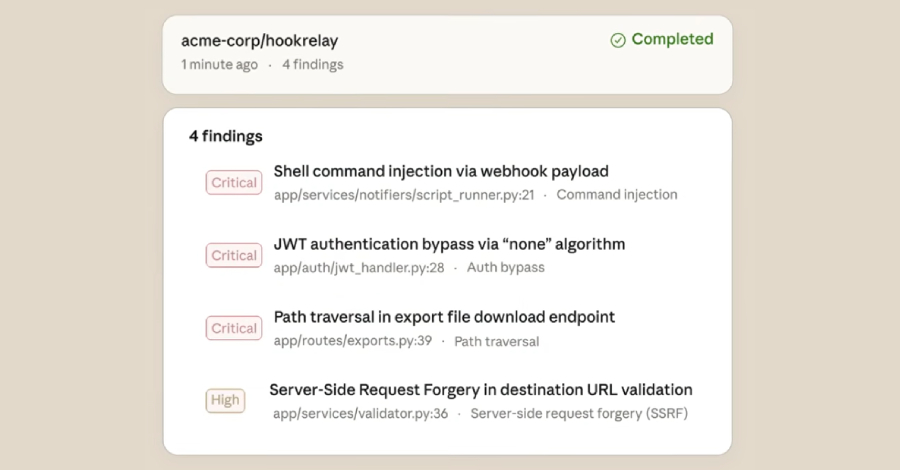
    Artificial intelligence (AI) company Anthropic has begun to roll out a new security feature for Claude Code that can scan a user’s software codebase for vulnerabilities and suggest patches.

    The capability, called Claude Code Security, is currently available in a limited research preview to Enterprise and Team customers.

    “It scans codebases for security vulnerabilities and suggests targeted software patches for human review, allowing teams to find and fix security issues that traditional methods often miss,” the company said in a Friday announcement.

    Anthropic said the feature aims to leverage AI as a tool to help find and resolve vulnerabilities to counter attacks where threat actors weaponize the same tools to automate vulnerability discovery. 

    With AI agents increasingly capable of detecting security vulnerabilities that have otherwise escaped human notice, the tech upstart said the same capabilities could be used by adversaries to uncover exploitable weaknesses more quickly than before. Claude Code Security, it added, is designed to counter this kind of AI-enabled attack by giving defenders an advantage and improving the security baseline.

    Anthropic claimed that Claude Code Security goes beyond static analysis and scanning for known patterns by reasoning the codebase like a human security researcher, as well as understanding how various components interact, tracing data flows throughout the application, and flagging vulnerabilities that may be missed by rule-based tools.

    Each of the identified vulnerabilities is then subjected to what it says is a “multi-stage verification process” where the results are re-analyzed to filter out false positives. The vulnerabilities are also assigned a severity rating to help teams focus on the most important ones.

    The final results are displayed to the analyst in the Claude Code Security dashboard, where teams can review the code and the suggested patches and approve them. Anthropic also emphasized that the system’s decision-making is driven by a human-in-the-loop (HITL) approach.

    “Because these issues often involve nuances that are difficult to assess from source code alone, Claude also provides a confidence rating for each finding,” Anthropic said. “Nothing is applied without human approval: Claude Code Security identifies problems and suggests solutions, but developers always make the call.”


    Source: thehackernews.com…

  • ClickFix Campaign Abuses Compromised Sites to Deploy MIMICRAT Malware

    ClickFix Campaign Abuses Compromised Sites to Deploy MIMICRAT Malware

    Ravie LakshmananFeb 20, 2026Malware / Threat Intelligence

    Cybersecurity researchers have disclosed details of a new ClickFix campaign that abuses compromised legitimate sites to deliver a previously undocumented remote access trojan (RAT) called MIMICRAT (aka AstarionRAT).

    “The campaign demonstrates a high level of operational sophistication: compromised sites spanning multiple industries and geographies serve as delivery infrastructure, a multi-stage PowerShell chain performs ETW and AMSI bypass before dropping a Lua-scripted shellcode loader, and the final implant communicates over HTTPS on port 443 using HTTP profiles that resemble legitimate web analytics traffic,” Elastic Security Labs said in a Friday report.

    According to the enterprise search and cybersecurity company, MIMICRAT is a custom C++ RAT with support for Windows token impersonation, SOCKS5 tunneling, and a set of 22 commands for comprehensive post-exploitation capabilities. The campaign was discovered earlier this month.

    It’s also assessed to share tactical and infrastructural overlaps with another ClickFix campaign documented by Huntress that leads to the deployment of the Matanbuchus 3.0 loader, which then serves as a conduit for the same RAT. The end goal of the attack is suspected to be ransomware deployment or data exfiltration.

    In the infection sequence highlighted by Elastic, the entry point is bincheck[.]io, a legitimate Bank Identification Number (BIN) validation service that was breached to inject malicious JavaScript code that’s responsible for loading an externally hosted PHP script. The PHP script then proceeds to deliver the ClickFix lure by displaying a fake Cloudflare verification page and instructing the victim to copy and paste a command into the Windows Run dialog to address the issue.

    This, in turn, leads to the execution of a PowerShell command, which then contacts a command-and-control (C2) server to fetch a second-stage PowerShell script that patches Windows event logging (ETW) and antivirus scanning (AMSI) before dropping a Lua-based loader. In the final stage, the Lua script decrypts and executes in memory shellcode that delivers MIMICRAT.

    The Trojan uses HTTPS for communicating with the C2 server, allowing it to accept two dozen commands for process and file system control, interactive shell access, token manipulation, shellcode injection, and SOCKS proxy tunneling.

    “The campaign supports 17 languages, with the lure content dynamically localized based on the victim’s browser language settings to broaden its effective reach,” security researcher Salim Bitam said. “Identified victims span multiple geographies, including a USA-based university and multiple Chinese-speaking users documented in public forum discussions, suggesting broad opportunistic targeting.”


    Source: thehackernews.com…

  • Cline CLI 2.3.0 Supply Chain Attack Installed OpenClaw on Developer Systems

    Cline CLI 2.3.0 Supply Chain Attack Installed OpenClaw on Developer Systems

    In yet another software supply chain attack, the open-source, artificial intelligence (AI)-powered coding assistant Cline CLI was updated to stealthily install OpenClaw, a self-hosted autonomous AI agent that has become exceedingly popular in the past few months.

    “On February 17, 2026, at 3:26 AM PT, an unauthorized party used a compromised npm publish token to publish an update to Cline CLI on the NPM registry: cline@2.3.0,” the maintainers of the Cline package said in an advisory. “The published package contains a modified package.json with an added postinstall script: ‘postinstall”: “npm install -g openclaw@latest.’”

    As a result, this causes OpenClaw to be installed on the developer’s machine when Cline version 2.3.0 is installed. Cline said no additional modifications were introduced to the package and there was no malicious behavior observed. However, it noted that the installation of OpenClaw was not authorized or intended.

    The supply chain attack affects all users who installed the Cline CLI package published on npm, specifically version 2.3.0, during an approximately eight-hour window between 3:26 a.m. PT and 11:30 a.m. PT on February 17, 2026. The incident does not impact Cline’s Visual Studio Code (VS Code) extension and JetBrains plugin.

    To mitigate the unauthorized publication, Cline maintainers have released version 2.4.0. Version 2.3.0 has since been deprecated and the compromised token has been revoked. Cline also said the npm publishing mechanism has been updated to support OpenID Connect (OIDC) via GitHub Actions.

    In a post on X, the Microsoft Threat Intelligence team said it observed a “small but noticeable uptick” in OpenClaw installations on February 17, 2026, as a result of the supply chain compromise of the Cline CLI package. According to StepSecurity, the compromised Cline package was downloaded roughly 4,000 times during the eight-hour stretch.

    Users are advised to update to the latest version, check their environment for any unexpected installation of OpenClaw, and remove it if not required.

    “Overall impact is considered low, despite high download counts: OpenClaw itself is not malicious, and the installation does not include the installation/start of the Gateway daemon,” Endor Labs researcher Henrik Plate said.

    “Still, this event emphasizes the need for package maintainers to not only enable trusted publishing, but also disable publication through traditional tokens – and for package users to pay attention to the presence (and sudden absence) of corresponding attestations.”

    Leveraging Clinejection to Leak Publication Secrets

    While it’s currently not clear who is behind the breach of the npm package and what their end goals were, it comes after security researcher Adnan Khan discovered that attackers could steal the repository’s authentication tokens through prompt injection by taking advantage of the fact that it is configured to automatically triage any incoming issue raised on GitHub.

    “When a new issue is opened, the workflow spins up Claude with access to the repository and a broad set of tools to analyze and respond to the issue,” Khan explained. “The intent: automate first-response to reduce maintainer burden.”

    But a misconfiguration in the workflow meant that it gave Claude excessive permissions to achieve arbitrary code execution within the default branch. This aspect, combined with a prompt injection embedded within the GitHub issue title, could be exploited by an attacker with a GitHub account to trick the AI agent into running arbitrary commands and compromise production releases.

    This shortcoming, which builds upon PromptPwnd, has been codenamed Clinejection. It was introduced in a source code commit made on December 21, 2025. The attack chain is outlined below –

    • Prompt Claude to run arbitrary code in issue triage workflow
    • Evict legitimate cache entries by filling the cache with more than 10GB of junk data, triggering GitHub’s Least Recently Used (LRU) cache eviction policy
    • Set poisoned cache entries matching the nightly release workflow’s cache keys
    • Wait for the nightly publish to run at around 2 a.m. UTC and trigger on the poisoned cache entry

    “This would allow an attacker to obtain code execution in the nightly workflow and steal the publication secrets,” Khan noted. “If a threat actor were to obtain the production publish tokens, the result would be a devastating supply chain attack.”

    “A malicious update pushed through compromised publication credentials would execute in the context of every developer who has the extension installed and set to update automatically.”

    In other words, the attack sequence employs GitHub Actions cache poisoning to pivot from the triage workflow to a highly privileged workflow, such as the Publish Nightly Release and Publish NPM Nightly workflows, and steal the nightly publication credentials, which have the same access as those used for production releases.

    As it turns out, this is exactly what happened, with the unknown threat actor weaponizing an active npm publish token (referred to as NPM_RELEASE_TOKEN or NPM_TOKEN) to authenticate with the Node.js registry and publish Cline version 2.3.0.

    “We have been talking about AI supply chain security in theoretical terms for too long, and this week it became an operational reality,” Chris Hughes, VP of Security Strategy at Zenity, said in a statement shared with The Hacker News. “When a single issue title can influence an automated build pipeline and affect a published release, the risk is no longer theoretical. The industry needs to start recognizing AI agents as privileged actors that require governance.”

    Source: thehackernews.com…

  • BeyondTrust Flaw Used for Web Shells, Backdoors, and Data Exfiltration

    BeyondTrust Flaw Used for Web Shells, Backdoors, and Data Exfiltration

    Ravie LakshmananFeb 20, 2026Vulnerability / Cyber Attack

    Threat actors have been observed exploiting a recently disclosed critical security flaw impacting BeyondTrust Remote Support (RS) and Privileged Remote Access (PRA) products to conduct a wide range of malicious actions, including deploying VShell and 

    The vulnerability, tracked as CVE-2026-1731 (CVSS score: 9.9), allows attackers to execute operating system commands in the context of the site user.

    In a report published Thursday, Palo Alto Networks Unit 42 said it detected the security flaw being actively exploited in the wild for network reconnaissance, web shell deployment, command-and-control (C2), backdoor and remote management tool installs, lateral movement, and data theft.

    The campaign has targeted financial services, legal services, high technology, higher education, wholesale and retail, and healthcare sectors across the U.S., France, Germany, Australia, and Canada.

    The cybersecurity company described the vulnerability as a case of sanitization failure that enables an attacker to leverage the affected “thin-scc-wrapper” script that’s reachable via WebSocket interface to inject and execute arbitrary shell commands in the context of the site user.

    “While this account is distinct from the root user, compromising it effectively grants the attacker control over the appliance’s configuration, managed sessions and network traffic,” security researcher Justin Moore said.

    The current scope of attacks exploiting the flaw range from reconnaissance to backdoor deployment –

    • Using a custom Python script to gain access to an administrative account.
    • Installing multiple web shells across directories, including a PHP backdoor that’s capable of executing raw PHP code or running arbitrary PHP code without writing new files to disk, as well as a bash dropper that establishes a persistent web shell.
    • Deploying malware such as VShell and Spark RAT.
    • Using out-of-band application security testing (OAST) techniques to validate successful code execution and fingerprint compromised systems.
    • Executing commands to stage, compress and exfiltrate sensitive data, including configuration files, internal system databases and a full PostgreSQL dump, to an external server.

    “The relationship between CVE-2026-1731 and CVE-2024-12356 highlights a localized, recurring challenge with input validation within distinct execution pathways,” Unit 42 said.

    “CVE-2024-12356’s insufficient validation was using third-party software (postgres), while CVE-2026-1731’s insufficient validation problem occurred in the BeyondTrust Remote Support (RS) and older versions of the BeyondTrust Privileged Remote Access (PRA) codebase.”

    With CVE-2024-12356 exploited by China-nexus threat actors like Silk Typhoon, the cybersecurity company noted that CVE-2026-1731 could also be a target for sophisticated threat actors.

    The development comes as the U.S. Cybersecurity and Infrastructure Security Agency (CISA) updated its Known Exploited Vulnerabilities (KEV) catalog entry for CVE-2026-1731 to confirm that the bug has been exploited in ransomware campaigns.


    Source: thehackernews.com…

  • Former Google Engineers Indicted Over Trade Secret Transfers to Iran

    Former Google Engineers Indicted Over Trade Secret Transfers to Iran

    Ravie LakshmananFeb 20, 2026Insider Threat / Corporate Espionage

    Two former Google engineers and one of their husbands have been indicted in the U.S. for allegedly committing trade secret theft from the search giant and other tech firms and transferring the information to unauthorized locations, including Iran.

    Samaneh Ghandali, 41, and her husband Mohammadjavad Khosravi (aka Mohammad Khosravi), 40, along with her sister Soroor Ghandali, 32, have been accused of conspiring to commit trade secret theft from Google and other leading technology companies, theft and attempted theft of trade secrets, and obstruction of justice.

    The three defendants, all Iranian nationals and residing in San Jose, were arrested on Thursday and made their initial appearances in federal district court in the California city.

    According to the U.S. Department of Justice (DoJ), the Ghandali sisters worked at Google before joining another technology company identified as Company 3. Khosravi is said to have been employed at a different company (named Company 2). All three of them landed jobs in the area of mobile computer processors.

    While the names of Company 2 and Company 3 were not disclosed, The Hacker News found that Soroor Ghandali worked as a hardware engineer intern at Google before joining Intel. Khosravi, on the other hand, was employed at Qualcomm as an ASIC design engineer.

    “As part of the alleged scheme to commit trade secret theft, the defendants used their employment to obtain access to confidential and sensitive information,” the DoJ said in a press release.

    “The defendants then exfiltrated confidential and sensitive documents, including trade secrets related to processor security and cryptography and other technologies, from Google and other technology companies to unauthorized third-party and personal locations, including to work devices associated with each other’s employers, and to Iran.”

    In a statement shared with Bloomberg, a Google spokesperson said the company has enhanced safeguards to protect its confidential information and immediately alerted law enforcement after discovering the incident. The trade secrets pertained to the company’s Tensor processor for Pixel phones.

    Samaneh Ghandali, per the department, transferred hundreds of files, including Google trade secrets, to a third-party communications platform, specifically to channels that had each of the defendant’s first names. Soroor Ghandali is also alleged to have exfiltrated numerous Google-related files, which contained trade secrets, to the same channels while working for the company.

    The trade secret files were subsequently copied to different personal devices, as well as a work device belonging to Khosravi and a work device issued to Soroor Ghandali by Company 3. The defendants then concealed their actions by submitting false, signed affidavits; destroyed the exfiltrated files from electronic devices; and manually took photographs of screens containing the documents’ contents instead of transferring the documents using the messaging app.

    “After Google’s internal security systems detected Samaneh Ghandali’s activity and Google revoked her access to company resources in August 2023, Samaneh Ghandali allegedly executed a signed affidavit claiming she had not shared Google’s confidential information with anyone outside the company,” the DoJ added.

    Furthermore, Samaneh Ghandali and Khosravi performed searches online and visited websites about deleting communications and other data. This included queries related to the duration for which a cellular service provider kept “messages to print out for court.”

    In the meantime, the couple is alleged to have continued accessing Google trade secrets stored on their personal devices for purposes of manually photographing hundreds of computer screens of both Google’s and Company 2’s sensitive information for an unspecified duration that stretched for months.

    Samaneh Ghandali also allegedly manually captured with her mobile phone about 24 photographs of Khosravi’s work computer screen containing Company 2 trade secret information on the night before the pair traveled to Iran in December 2023. These photographs were then accessed from a personal device associated with Samaneh Ghandali in Iran.

    If convicted, each defendant faces a maximum sentence of 10 years in prison and a $250,000 fine for each count of trade secret theft charges and a maximum sentence of 20 years in prison and a $250,000 fine for the count of obstruction of justice.

    The development comes less than a month after another ex-Google engineer, Linwei Ding, was convicted in the U.S. for stealing thousands of the company’s confidential documents to build a startup in China.


    Source: thehackernews.com…

  • FBI Reports 1,900 ATM Jackpotting Incidents Since 2020, $20M Lost in 2025

    FBI Reports 1,900 ATM Jackpotting Incidents Since 2020, $20M Lost in 2025

    Ravie LakshmananFeb 20, 2026Financial Crime / Banking Security

    The U.S. Federal Bureau of Investigation (FBI) has warned of an increase in ATM jackpotting incidents across the country, leading to losses of more than $20 million in 2025.

    The agency said 1,900 ATM jackpotting incidents have been reported since 2020, out of which 700 took place last year. In December 2025, the U.S. Department of Justice (DoJ) said about $40.73 million has been collectively lost to jackpotting attacks since 2021.

    “Threat actors exploit physical and software vulnerabilities in ATMs and deploy malware to dispense cash without a legitimate transaction,” the FBI said in a Thursday bulletin.

    The jackpotting attacks involve the use of specialized malware, such as Ploutus, to infect ATMs and force them to dispense cash. In most cases, cybercriminals have been observed gaining unauthorized access to the machines by opening an ATM face with widely available generic keys.

    There are at least two different ways by which the malware is deployed: Removing the ATM’s hard drive, followed by either connecting it to their computer, copying it to the hard drive, attaching it back to the ATM, and rebooting the ATM, or replacing it entirely with a foreign hard drive preloaded with the malware and rebooting it.

    Regardless of the method used, the end result is the same. The malware is designed to interact directly with the ATM hardware, thereby getting around any security controls present in the original ATM software.

    Because the malware does not require a connection to an actual bank card or customer account to dispense cash, it can be used against ATMs of different manufacturers with little to no code changes, as the underlying Windows operating system is exploited during the attack.

    Ploutus was first observed in Mexico in 2013. Once installed, it grants threat actors complete control over an ATM, enabling them to trigger cash-outs that the FBI said can occur in minutes and are harder to detect until after the money is withdrawn.

    “Ploutus malware exploits the eXtensions for Financial Services (XFS), the layer of software that instructs an ATM what to physically do,” the FBI explained.

    “When a legitimate transaction occurs, the ATM application sends instructions through XFS for bank authorization. If a threat actor can issue their own commands to XFS, they can bypass bank authorization entirely and instruct the ATM to dispense cash on demand.”

    The agency has outlined a long list of recommendations that organizations can adopt to mitigate jackpotting risks. This includes tightening physical security by installing threat sensors, setting up security cameras, and changing standard locks on ATM devices.

    Other measures involve auditing ATM devices, changing default credentials, configuring an automatic shutdown mode once indicators of compromise are detected, enforcing device allowlisting to prevent connection of unauthorized devices, and maintaining logs.


    Source: thehackernews.com…

  • Ukrainian National Sentenced to 5 Years in North Korea IT Worker Fraud Case

    Ukrainian National Sentenced to 5 Years in North Korea IT Worker Fraud Case

    Ravie LakshmananFeb 20, 2026Cybercrime / Law Enforcement

    A 29-year-old Ukrainian national has been sentenced to five years in prison in the U.S. for his role in facilitating North Korea’s fraudulent information technology (IT) worker scheme.

    In November 2025, Oleksandr “Alexander” Didenko pleaded guilty to wire fraud conspiracy and aggravated identity theft for stealing the identities of U.S. citizens and selling them to IT workers to help them land jobs at 40 U.S. companies and draw regular salaries, which were then funneled back to the regime to support its weapons programs. He was apprehended by Polish authorities in late 2024, and later extradited to the U.S.

    Didenko has also been ordered to serve 12 months of supervised release and to pay $46,547.28 in restitution. Last year, Didenko also agreed to forfeit more than $1.4 million, which includes about $181,438 in U.S. dollars and cryptocurrency seized from him and his co-conspirators.

    The defendant is said to have run a website named Upworksell[.]com to help overseas IT workers buy or rent stolen or borrowed identities since the start of 2021. The IT workers abused these identities to apply for jobs on freelance work platforms based in California and Pennsylvania. The site was seized by authorities on May 16, 2024.

    In addition, Didenko paid individuals in the U.S. to receive and host laptops at their residences in Virginia, Tennessee and California. The idea was to give the impression that the workers were located in the country, when, in reality, they were connecting remotely from countries like China, where they were dispatched to.

    As part of the criminal scheme, Didenko managed as many as 871 proxy identities and facilitated the operation of at least three U.S.-based laptop farms. One of the computers was sent to a laptop farm run by Christina Marie Chapman in Arizona. Chapman was arrested in May 2024 and sentenced to 102 months in prison in July 2025 for participating in the scheme.

    Furthermore, he enabled his North Korean clients to access the U.S. financial system through Money Service Transmitters instead of having to open an account at a bank within the U.S. These money transfer services were used to move employment income to foreign bank accounts. Officials said Didenko’s clients were paid hundreds of thousands of dollars for their work.

    “Defendant Didenko’s scheme funneled money from Americans and U.S. businesses, into the coffers of North Korea, a hostile regime,” said U.S. Attorney Jeanine Ferris Pirro. “Today, North Korea is not only a threat to the homeland from afar, it is an enemy within.”

    “By using stolen and fraudulent identities, North Korean actors are infiltrating American companies, stealing information, licensing, and data that is harmful to any business. But more than that, money paid to these so-called employees goes directly to munitions programs in North Korea.”

    Despite continued law enforcement actions, the Hermit Kingdom’s conspiracy shows no signs of stopping. If anything, the operation has continued to evolve with new tactics and techniques to evade detection.

    According to a report from threat intelligence firm Security Alliance (SEAL) last week, the IT workers have begun to apply for remote positions using real LinkedIn accounts of individuals they’re impersonating in an effort to make their fraudulent applications look authentic.


    Source: thehackernews.com…

  • Identity Cyber Scores: The New Metric Shaping Cyber Insurance in 2026

    Identity Cyber Scores: The New Metric Shaping Cyber Insurance in 2026

    The Hacker NewsFeb 20, 2026Cyber Insurance / Password Security

    With one in three cyber-attacks now involving compromised employee accounts, insurers and regulators are placing far greater emphasis on identity posture when assessing cyber risk. 

    For many organizations, however, these assessments remain largely opaque. Elements such as password hygiene, privileged access management, and the extent of multi-factor authentication (MFA) coverage are increasingly influential in how cyber risk and insurance costs are evaluated.

    Understanding the identity-centric factors behind these assessments is critical for organizations seeking to demonstrate lower risk exposure and secure more favorable insurance terms.

    Why identity posture now drives underwriting

    With the global average cost of a data breach reaching $4.4 million in 2025, more organizations are turning to cyber insurance to manage financial exposure. In the UK, coverage has increased from 37% in 2023 to 45% in 2025, but rising claims volumes are prompting insurers to tighten underwriting requirements. 

    Credential compromise remains one of the most reliable ways for attackers to gain access, escalate privileges, and persist within an environment. For insurers, strong identity controls reduce the likelihood that a single compromised account can lead to widespread disruption or data loss, supporting more sustainable underwriting decisions.

    What insurers want to see in identity security

    Password hygiene and credential exposure

    Despite the growing use of multi-factor authentication and passwordless initiatives, passwords still play a key role in authentication. Organizations should pay particular attention to the behaviors and issues that increase the risk of credential theft and abuse, including: 

    • Password reuse across identities, particularly among administrative or service accounts, increases the likelihood that one stolen credential leads to broader access.
    • Legacy authentication protocols are still common in networks and frequently abused to harvest credentials. NTLM persists in many environments despite being functionally replaced by Kerberos in Windows 2000.
    • Dormant accounts with valid credentials, which act as unmonitored entry points and often retain unnecessary access.
    • Service accounts with never-expiring passwords, creating long-lived, low-visibility attack paths.
    • Shared administrative credentials, reduce accountability and amplify the impact of compromise.

    From an underwriting perspective, evidence that an organization understands and actively manages these risks is often more important than the presence of individual technical controls. Regular audits of password hygiene and credential exposure help demonstrate maturity and intent to reduce identity-driven risk.

    Privileged access management

    Privileged access management is a critical measure of an organization’s ability to prevent and mitigate breaches. Privileged accounts can have high-level access to systems and data, but are frequently over-permissioned. As a result, insurers pay close attention to how these accounts are governed.

    Service accounts, cloud administrators, and delegated privileges outside central monitoring significantly elevate risk. This is especially true when they operate without MFA or logging.

    Excessive membership in Domain Admin or Global Administrator roles and overlapping administrative scopes all suggest that privilege escalation would be both rapid and difficult to contain. 

    Poorly governed or unknown privileged access is typically viewed as higher risk than a small number of tightly controlled administrators. Security teams can use tools such as Specops Password Auditor to identify stale, inactive, or over-privileged administrative accounts and prioritize remediation before those credentials are abused.

    Specops Password Auditor – Dashboard

    When determining the likelihood of a damaging breach, the question is straightforward: if an attacker compromises a single account, how quickly can they become an administrator? Where the answer is “immediately” or “with minimal effort,” premiums tend to reflect that exposure.

    MFA coverage 

    Most organizations can credibly state that MFA has been deployed. However, MFA only meaningfully reduces risk when it is consistently enforced across all critical systems and accounts. In one documented case, the City of Hamilton was denied an $18 million cyber insurance payout after a ransomware attack because MFA had not been fully implemented across affected systems.

    While MFA isn’t infallible, fatigue attacks first require valid account credentials and then depend on a user approving an unfamiliar authentication request, an outcome that is far from guaranteed.

    Meanwhile, accounts that authenticate via older protocols, non-interactive service accounts, or privileged roles exempted for convenience all offer viable bypass paths once initial access is achieved.

    That’s why insurers increasingly require MFA for all privileged accounts, as well as for email and remote access. Organizations that neglect it may face higher premiums.

    Four steps to improve your identity cyber score 

    There are many ways organizations can improve identity security, but insurers look for evidence of progress in a few key areas:

    1. Eliminate weak and shared passwords: Enforce minimum password standards and reduce password reuse, particularly for administrative and service accounts. Strong password hygiene limits the impact of credential theft and reduces the risk of lateral movement following initial access.
    2. Apply MFA across all critical access paths: Ensure MFA is enforced on remote access, cloud applications, VPNs, and all privileged accounts. Insurers increasingly expect MFA coverage to be comprehensive rather than selectively applied.
    3. Reduce permanent privileged access: Limit permanent administrative rights wherever practical and adopt just-in-time or time-bound access for elevated tasks. Fewer always-on privileged accounts directly reduce the impact of credential compromise.
    4. Regularly review and certify access: Conduct routine reviews of user and privileged permissions to ensure they align with current roles. Stale access and orphaned accounts are common red flags in insurance assessments.

    Insurers increasingly expect organizations to demonstrate not only that identity controls exist, but that they are actively monitored and improved over time.

    Specops Password Auditor supports this by providing clear visibility into password exposure within Active Directory and enforcing controls that reduce credential-based risk.

    To understand how these controls can be applied in your environment and aligned with insurer expectations, speak with a Specops expert or request a live demo.

    Found this article interesting? This article is a contributed piece from one of our valued partners. Follow us on Google News, Twitter and LinkedIn to read more exclusive content we post.


    Source: thehackernews.com…

  • ThreatsDay Bulletin: OpenSSL RCE, Foxit 0-Days, Copilot Leak, AI Password Flaws & 20+ Stories

    ThreatsDay Bulletin: OpenSSL RCE, Foxit 0-Days, Copilot Leak, AI Password Flaws & 20+ Stories

    Ravie LakshmananFeb 19, 2026Cybersecurity / Hacking News

    The cyber threat space doesn’t pause, and this week makes that clear. New risks, new tactics, and new security gaps are showing up across platforms, tools, and industries — often all at the same time.

    Some developments are headline-level. Others sit in the background but carry long-term impact. Together, they shape how defenders need to think about exposure, response, and preparedness right now.

    This edition of ThreatsDay Bulletin brings those signals into one place. Scan through the roundup for quick, clear updates on what’s unfolding across the cybersecurity and hacking landscape.

    1. Loader pipeline drives rapid domain takeover

      Another new ClickFix campaign detected in February 2026 has been observed delivering a malware-as-a-service (MaaS) loader known as Matanbuchus 3.0. Huntress, which dissected the attack chain, said the ultimate objective of the intrusion was to deploy ransomware or exfiltrate data based on the fact that the threat actor rapidly progressed from initial access to lateral movement to domain controllers via PsExec, rogue account creation, and Microsoft Defender exclusion staging. The attack also led to the deployment of a custom implant dubbed AstarionRAT that supports 24 commands to facilitate credential theft, SOCKS5 proxy, port scanning, reflective code loading, and shell execution. According to data from the cybersecurity company, ClickFix fueled 53% of all malware loader activity in 2025.

    Security news rarely breaks in isolation. One incident leads to another, new research builds on older findings, and attacker playbooks keep adjusting along the way. The result is a constant stream of signals that are easy to miss without a structured view.

    This roundup pulls those signals together into a single, readable snapshot. Go through the full list to get quick clarity on the developments shaping defender priorities and risk conversations right now.


    Source: thehackernews.com…

  • Microsoft Patches CVE-2026-26119 Privilege Escalation in Windows Admin Center

    Microsoft Patches CVE-2026-26119 Privilege Escalation in Windows Admin Center

    Ravie LakshmananFeb 19, 2026Vulnerability / Network Security

    Microsoft has disclosed a now-patched security flaw in Windows Admin Center that could allow an attacker to escalate their privileges.

    Windows Admin Center is a locally deployed, browser-based management tool set that lets users manage their Windows Clients, Servers, and Clusters without the need for connecting to the cloud.

    The high-severity vulnerability, tracked as CVE-2026-26119, carries a CVSS score of 8.8 out of a maximum of 10.0

    “Improper authentication in Windows Admin Center allows an authorized attacker to elevate privileges over a network,” Microsoft said in an advisory released on February 17, 2026. “The attacker would gain the rights of the user that is running the affected application.”

    Microsoft credited Semperis researcher Andrea Pierini with discovering and reporting the vulnerability. It’s worth mentioning that the security issue was patched by the tech giant in Windows Admin Center version 2511 released in December 2025. 

    While the Windows maker makes no mention of this vulnerability being exploited in the wild, it has been tagged with an “Exploitation More Likely” assessment.

    Technical details related to CVE-2026-26119 are presently under wraps, but that could change soon. In a post shared on LinkedIn, Pierini said the vulnerability could “allow a full domain compromise starting from a standard user” under certain conditions.


    Source: thehackernews.com…